You passed the commercial checkride — the moment every conversation about commercial pilot privileges and limitations actually starts. The DPE shook your hand, you walked out to the parking lot, and somewhere in the back of your mind a little voice said finally, someone's going to pay me to fly this thing.
Then you tried to figure out what "this thing" actually was, and the voice got a lot quieter.
Here's the part nobody tells you clearly in ground school: the commercial certificate does not make you an air taxi. It doesn't make you Uber with wings. It makes you eligible to be paid for flying, under a specific set of rules that most new commercial pilots learn the hard way — usually from a well-meaning friend's cousin who wants to split gas money to Key West and "won't tell anyone."
So let's clear this up properly, because getting it wrong isn't a warning-letter mistake. It's a certificate-action mistake.
The Certificate Gives You Eligibility, Not a Business License
FAR 61.133 is short and deceptively generous, and it's the starting point for understanding commercial pilot privileges and limitations. It says a commercial pilot may act as PIC of an aircraft carrying persons or property for compensation or hire, as long as they're qualified under the rules that actually govern that kind of flying. That last clause is where the entire conversation lives.
Your commercial certificate is the ticket that lets you stand in line for paid flying. It is not the ticket that lets you operate an airline. Those are two completely different regulatory worlds, and the FAA does not consider them interchangeable just because you have a nice new plastic card.
One limitation worth flagging early: without an instrument rating, you can't carry passengers for hire on cross-country flights over 50 nautical miles or at night. That single line has ended more than one enthusiastic weekend plan, and it's worth building into your training timeline rather than discovering it after you've already made a promise to someone.

What You Can Actually Get Paid to Do
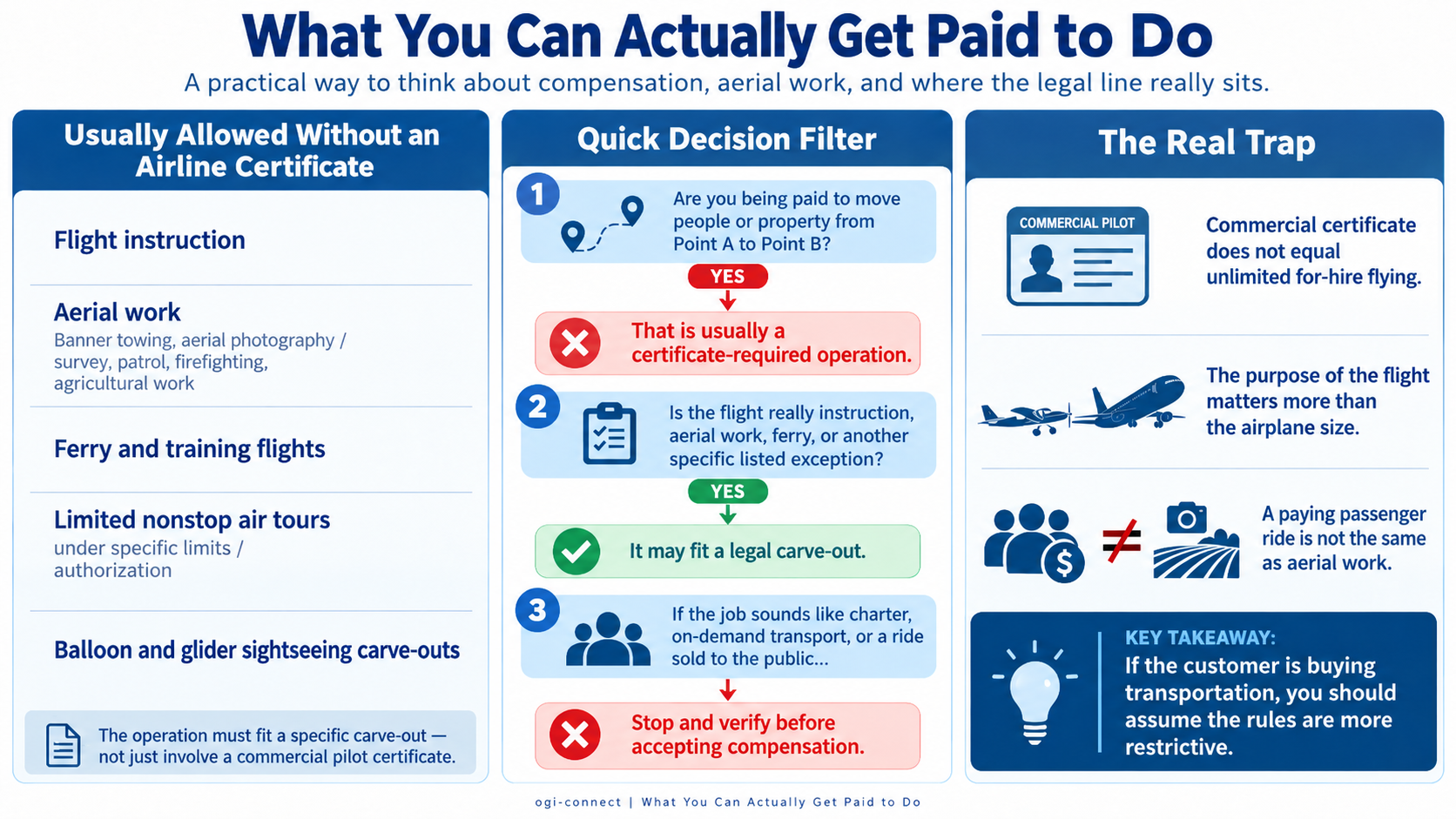
There's a specific list of operations — carved out under 14 CFR 119.1(e) — that a commercial pilot can perform for compensation without holding an airline operating certificate. This is the list that matters, and it's shorter than most people hope:
Flight instruction sits at the top, and it's the one almost every commercial pilot ends up using, because it requires nothing beyond your CFI certificate and it's the most accessible legal path to actually getting paid to fly regularly. Aerial work is next — crop dusting, banner towing, aerial photography and survey, firefighting, and pipeline or powerline patrol all qualify. Ferry and training flights (non-revenue repositioning) are fine. Nonstop commercial air tours are allowed under a Letter of Authorization, but they're capped at 25 statute miles from the departure airport, 30 seats, and 7,500 pounds of payload. Balloon and glider sightseeing has its own narrow carve-out too.
Notice what's missing from that list: taking a paying stranger from Point A to Point B because they found you online and you had a free Saturday. That's not aerial work. That's an airline, legally speaking, and the FAA doesn't care how small your airplane is. If none of the categories above fit what you're picturing, the honest move is to hold off on advertising anything to the public until you've either built out a Part 135 operation or picked one of the paths above — there's no shortcut version of an air carrier certificate.
The Line You Can't See Until You've Crossed It: Common Carriage
This is where things get genuinely confusing, and it's worth sitting with for a minute instead of skimming past it.
Common carriage happens when you (1) hold yourself out as willing to (2) transport people or property (3) from place to place (4) for compensation. All four elements generally have to be present, but "holding out" is the one that catches new commercial pilots off guard, because it doesn't require a business card or an LLC. A Facebook post. A flight-sharing app. A flyer at the FBO. Telling your entire hangar chat you're "available for hire this weekend." All of it can count as holding out to the FAA, whether or not a single dollar changes hands.
The Flytenow case is the textbook example, and it's worth knowing if you're ever tempted to post a route online and split costs with strangers — the FAA and the courts agreed that publicly advertising a flight to anyone willing to pay was common carriage, not legitimate cost-sharing, even though it looked identical to something private pilots do informally all the time.
Private Carriage and Genuine Cost-Sharing
Private carriage, by contrast, generally involves a specific, negotiated arrangement — not an open invitation to the public. And genuine cost-sharing (splitting expenses pro rata, with the pilot having their own independent reason for the flight) is a different animal entirely from advertising a ride for pay. The moment you're soliciting strangers instead of sharing a flight you were already taking, you've usually left cost-sharing behind.
If any of this feels like a gray area, that's because it often is — which is exactly why the FAA's own advisory circular on the subject, AC 120-12A, exists. It's not exciting reading. It is, however, the actual authority, and it's worth five minutes if you're ever unsure whether a specific arrangement crosses the line.
Why This Matters More Than It Seems To
New commercial pilots tend to treat commercial pilot privileges and limitations as a technicality to Google once and forget. It isn't. It's the difference between building a logbook and building a case file.
The FAA doesn't need you to be running a full charter operation to take action. A single flight that meets the common carriage test — one Facebook post, one paying stranger, one "sure, I'll fly you down for gas money" — is enough. And unlike a checkride bust, this isn't something you get to retake next week. None of this means memorizing the CFR before your first paid flight. It means treating "can I actually get paid for this" as a real question worth five minutes before you say yes, not something to sort out after the fact.
The good news is that the legitimate path is right in front of most new commercial pilots the entire time: get your CFI, and you're instantly and unambiguously allowed to get paid to fly, as often as you can find students, with zero gray area to worry about. It's not a consolation prize. For a lot of working pilots, it's the fastest, cleanest, most defensible way to start logging paid time while everything else on that Part 119.1(e) list stays out of reach for a while longer. If you're weighing how fast you could realistically get there, the Part 61 vs Part 141 timeline breakdown and our guide to how to become a flight instructor both walk through the path in detail — and both matter just as much to understanding commercial pilot privileges and limitations as the regulation itself.
Bookmark this one. It's worth a re-read before your first paid flight of any kind, whether that's your first student in the right seat or your first banner tow contract, because the definitions here don't change even as the opportunities do.