Part Two: Building a Personal Brand as a Flight Instructor
Or: Why Your Students Are Googling You Before They Ever Call You
Alright. You made it through Part One.
You audited the pipeline. You committed to getting the MEI you've been "about to get" since the Obama administration. You built a ground curriculum that doesn't rely on a napkin and your best impression of someone who definitely remembered to review this section.
Gold star. Seriously.
Now we're going to talk about something that's going to make approximately half of you close the browser tab.
Personal branding.
No, wait — come back.
I know. I know what you're thinking. "I became a flight instructor to fly airplanes and teach people not to die, not to curate a content strategy."
And you're right. That's a completely reasonable reaction. Personal branding does sound like something invented by a 24-year-old at a Rooftop Networking Event™ who's never been within 500 feet of a Cessna and calls himself a "thought leader" while drinking a matcha latte that costs more than your first solo fuel bill.
But here's the thing your DPE never told you and your CFI ground school definitely skipped:
The pilots and instructors who get called first aren't always the most qualified. They're the ones someone already knew.
That's it. That's the whole secret. Referrals in 2026 matter more than they have in years — and a personal brand is just a referral engine you build on purpose instead of leaving to chance and hoping your one enthusiastic student mentions you to literally anyone.
So. Let's do this. Painlessly. With minimal ring lights required.
Why This Matters More Than You Think — Even If the Phrase "Personal Brand" Makes You Want to Go Fly VFR Into a Cloud
Here's the actual market reality right now:
There are more flight instructors than there have ever been. FAA civil airman statistics show pilot certificate issuances kept climbing straight through 2024. Your potential students have Google, Facebook groups, YouTube, Reddit, and approximately four different apps that let them read reviews, watch videos, and form a complete opinion about you before they ever dial your number.
They are researching you. Right now. Before you even know they exist.
If nothing comes up when they look — no content, no reviews, no visible presence beyond your name buried on the school's staff page — you are competing on proximity and price alone.
You become the airport car rental place. People use it because it's there. Nobody drove past three other rental companies to get to it specifically. Nobody told a friend about it. Nobody left a review that said "this Budget at Gate C changed my life."
That's not the position you want to be in. Especially when the market is slow and every available student is doing more research than ever before pulling the trigger on training.
A personal brand doesn't mean you need a podcast, a ring light, or opinions about content calendars. It means that when a student is choosing between three CFIs, they can find you, understand what you stand for, and decide you're the one they want to train with.
That's the whole game. Let's make it practical.
What a Personal Brand Actually Is (and Isn't, Since We're Apparently Doing This)
Let's clear the air first, because half the reason CFIs avoid this topic is that they're picturing the wrong thing entirely.
It is NOT:
A logo
A color palette
Posting a stock photo of a Cessna at sunset with the caption "Cleared for the option on life ✈️"
Referring to yourself as an "aviation educator and certified flight professional" in your bio while your LinkedIn has had zero activity since 2019
A personal website with a hero photo of you squinting heroically into the middle distance on the ramp

It IS:
What people say about you when you're not in the room.
Which, for a CFI, is almost entirely what your students tell other people after they've trained with you. That's it. That's the engine. Every lesson you give, every debrief you send, every piece of content you put out, every honest answer you give in a Facebook group — that's brand-building. Whether you call it that or not.
"She's the one who actually explains why things work, not just what to memorize."
"He's brutally honest about what you still need to work on, but you always leave knowing exactly what to fix."
"Every single lesson she sends a written debrief. I've never been more prepared for anything in my life."
That's a brand. That's a reputation that travels without you having to be in the room. And it gets built — intentionally or accidentally — by every interaction you have with every student.
The question isn't whether you have a brand. You already have one.
The question is whether you built it on purpose or just kind of stumbled into it like a student discovering they've been leaning on the wrong rudder for six lessons.
How to Actually Build It Without Losing Your Mind
Step 1: Get Clear on What You're Specifically About
"I'm a CFI who teaches all levels" is the aviation equivalent of a restaurant with a 47-page menu.
Technically capable of everything. Actually known for nothing. Genuinely terrifying to order from.
The CFIs who build real reputations — the ones who have a waitlist while the instructor down the hall is staring at an empty schedule — are the ones who got specific. They didn't try to be everything to everyone. They picked a lane and drove down it until people started associating their name with it automatically.
So ask yourself, honestly:
What kind of student do I genuinely do my best work with? The nervous low-timer who needs confidence built lesson by lesson? The instrument student who's technically solid in the plane but completely falls apart the moment a DPE walks in? The career changer in their 40s who needs someone who actually understands the math of building the right hours, not just any hours?
What do I know so well I could teach it in my sleep, at altitude, in actual IMC, with a student who has asked me what the fuel selector does four times this lesson alone?
What do I believe about flight training that most instructors either don't say out loud or genuinely haven't figured out yet?
That last question is where your brand actually lives.
It's the slightly contrarian, specific, honest thing you actually believe — about how checkride prep works, about how students should study, about what the oral exam is really testing — that you teach differently because you've watched the conventional approach fail too many times.
Find that. Write it down somewhere. Build everything else around it.
Because "I teach all levels out of [Airport Identifier]" isn't a brand. It's a directory listing. And directory listings don't get referrals.
Step 2: Say It Out Loud — In Writing, Regularly
Here is the uncomfortable truth:
You already know more about flight training than the vast majority of people who will ever look for a CFI. You have opinions, experience, frameworks, and hard-won lessons that student pilots would genuinely find valuable.
And you are keeping all of it in your head, in the cockpit, and in debriefs that exactly two people hear before they drive home and forget 60% of it by dinner.
Start putting it somewhere people can actually find it.
This doesn't have to be complicated:
Write a post about the single most common thing you see students do wrong before a stage check. Three paragraphs. Your real answer, not the textbook answer. Post it.
Share your honest take on what it actually takes to prepare for an oral exam in 2026 — not "study the ACS" (thanks, extremely helpful) but the actual structure and approach that works.
Explain one concept — airspace, weather, systems, IFR procedures — exactly the way you explain it in the debrief chair. Not FAA handbook language. Your language. The way that actually makes it click.
This does not need to be a production. You are not filming a nature documentary. You don't need a script, a studio, or a camera that costs more than a discovery flight.
A few hundred words of real insight, published consistently, will do more for your reputation over the next 12 months than the most beautifully designed logo anyone has ever created.
And if writing feels hard, remember this: you can talk for 45 minutes about P-factor, wake turbulence, and the finer points of soft-field technique without checking a single note. Writing is just talking, but slower and with spellcheck. You already know how to do the hard part.

Step 3: Let Your Students Do the Talking (Because They're More Convincing Than You Are)
Here's a thing that's true and slightly uncomfortable:
You telling people you're a great instructor is fine. It's expected. It's about as persuasive as a pilot telling you their own checkride went great.
Your students telling people you're a great instructor? That's the reason new students show up to the first call already half-convinced.
Ask for testimonials. But here's the critical part — ask for specific ones.
"He's amazing!" is a lovely thing for someone to say. It will help absolutely no one decide to book a discovery flight. It's the aviation equivalent of ATIS information with no actual weather data. Technically a broadcast. Completely useless for planning purposes.
"She noticed I was fixating on the runway numbers during pattern work before I even realized I was doing it. We fixed it in two lessons. I passed my checkride first try." — now THAT is a story. That makes someone else sit up and think I want that specific result from that specific person.
The key is timing. Ask after the moments that actually land:
First solo
Stage check passed
Written test cleared
Checkride complete
That's when the feeling is fresh. That's when students have words for what happened. That's when the specific, useful testimonial comes out instead of the generic nice-but-useless one.
Make it easy. Send a short follow-up message. Two sentences. One question: "What's one specific thing that helped you get here?" Done.
Step 4: Pick One Platform. Show Up There. Actually.
Let's talk about the mistake that kills most CFI brand-building attempts before they get any traction:
Spreading across every platform at once, posting inconsistently, getting discouraged when nothing happens in 30 days, and quietly disappearing.
This is the social media equivalent of filing a flight plan and never departing. Technically you had intentions. Nobody saw you go anywhere.
Here's the only formula that actually works:
One platform. Every week. Something real.
That's it. One. The algorithm doesn't care about your intentions or your five-platform strategy. It rewards the people who actually show up consistently in one place. So pick based on where your students actually are — not where you're theoretically most comfortable:

Facebook — Still the dominant platform for local and regional aviation communities. Student pilot groups, flying club pages, FBO communities. If your students are learning to fly at a local airport and they're between 30 and 55, they're probably on Facebook.
Instagram — Built for aspiration. Student pilots dream about flying long before they commit to paying for it. They're on Instagram watching flying content, imagining themselves up there. Show them what it actually looks like from your seat.
LinkedIn — The right move if you're building toward chief instructor, school ownership, or training management. Your reputation here is built with the people who hire and promote instructors, not just the ones who want to learn from them.
YouTube — The slowest build. The longest shelf life. A single well-made explainer video on a topic your student pilots are searching for can bring you inquiries for three years. If you can get comfortable on camera, this is the highest long-term ROI of any platform.
Pick one. Commit to it the way you commit to a checkride date — with a plan, a calendar, and the understanding that you don't just skip it because you're not feeling it that week.
You can always add a second platform later. But you have to actually show up to the first one consistently before the second one matters at all.
The Bigger Picture: Why Right Now Is the Right Time
Here's what the slow period in aviation actually is, when you step back and look at it clearly:
It's a filter.
The instructors who use it to build — who sharpen their skills, who get specific about what they offer, who start showing up consistently in public — those are the ones who come out the other side with something real. A reputation. A waitlist. A name that comes up in conversation when someone asks "do you know a good CFI?"
The instructors who wait it out, who tell themselves they'll start posting "when things pick up," who keep being the best-kept secret at their home airport — those are the ones who end up doing the same thing in the next slow period. And the one after that.
Aviation is cyclical. It has always been cyclical. The instructors who built something during the quiet seasons are the ones with options when the busy seasons return.
You already have the knowledge. You already have the experience. You already have opinions worth sharing and students worth telling.
The only thing left is to stop keeping it to yourself.
Join Us Live This Saturday — Power Hour on Exactly This Topic
If any of this landed — the positioning piece, the content piece, the "I know I should be doing more but I genuinely don't know where to start" piece — this Saturday is built for you.
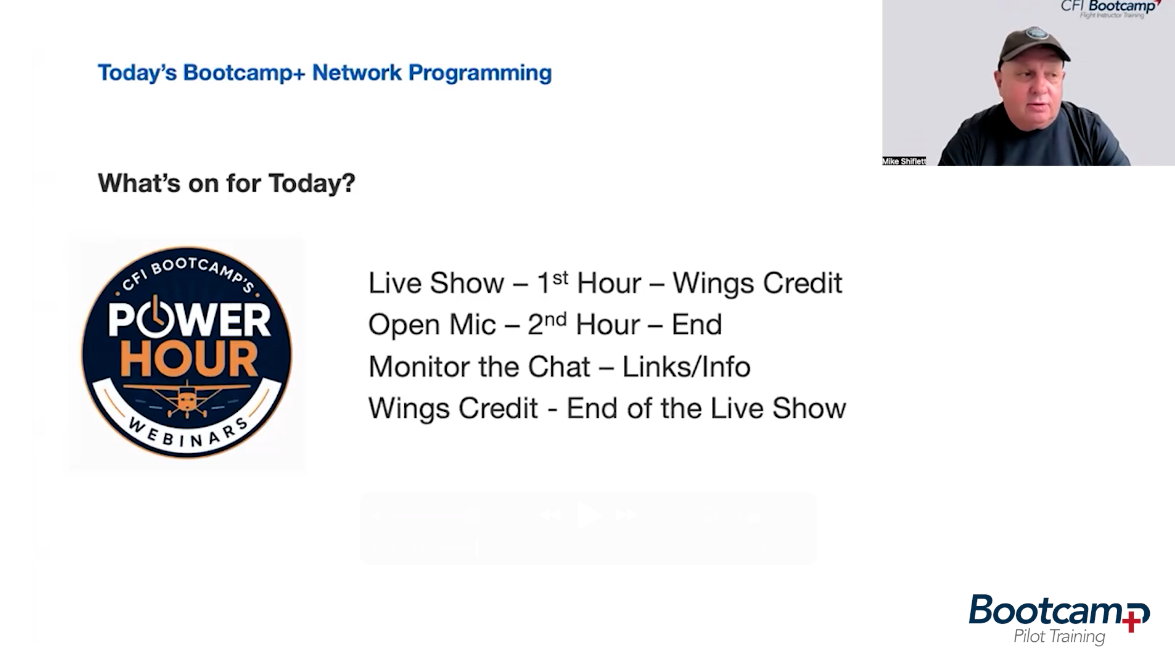
Saturday at 12:00 PM ET, CFI Bootcamp is hosting a live Power Hour session:
Building a Personal Brand as a CFI: Why It Matters and How to Do It Authentically
We're going live to cover:
How to identify your actual positioning as an instructor — the real, specific version, not the generic one
What content actually works for CFIs who want to build visibility without becoming full-time content creators
How to build a reputation that brings students to you instead of whoever happens to be available
The most common mistakes CFIs make when they try to "put themselves out there" — and exactly how to avoid them
This is live. Interactive. A real conversation — not a 45-minute PowerPoint presentation narrated at you while you quietly check the weather on your other tab.
Come with questions. Come with skepticism. Come with the slow-period frustration you've been carrying around all week. We'll actually work through it.
Grab Your Spot → Power Hour Session
The market is cyclical. It always has been. The instructors who built during the slow periods came out the other side with something the reactive ones didn't have.
You're not too late. You're early for the next cycle.
Build the brand. Sharpen the skills. Show up on Saturday at noon.
CFI Bootcamp | Ogi Connect helps flight instructors build efficient, outcome-focused training practices — without the scattered study and wasted hours. Browse tools, courses, and resources at cfibootcamp.com.