It's Sunday night. You've got three students tomorrow, one of them is a stage check, and you're sitting at the kitchen table rebuilding a lesson plan you're pretty sure you already wrote in March. Somewhere on your laptop is a folder called "Lesson Plans FINAL" with four more folders inside it also called "FINAL." This is exactly the gap a lesson plan library is built to close.
This is not a discipline problem. You are not lazy. You are doing what every CFI does when there's no system: reinventing the wheel one flight at a time.
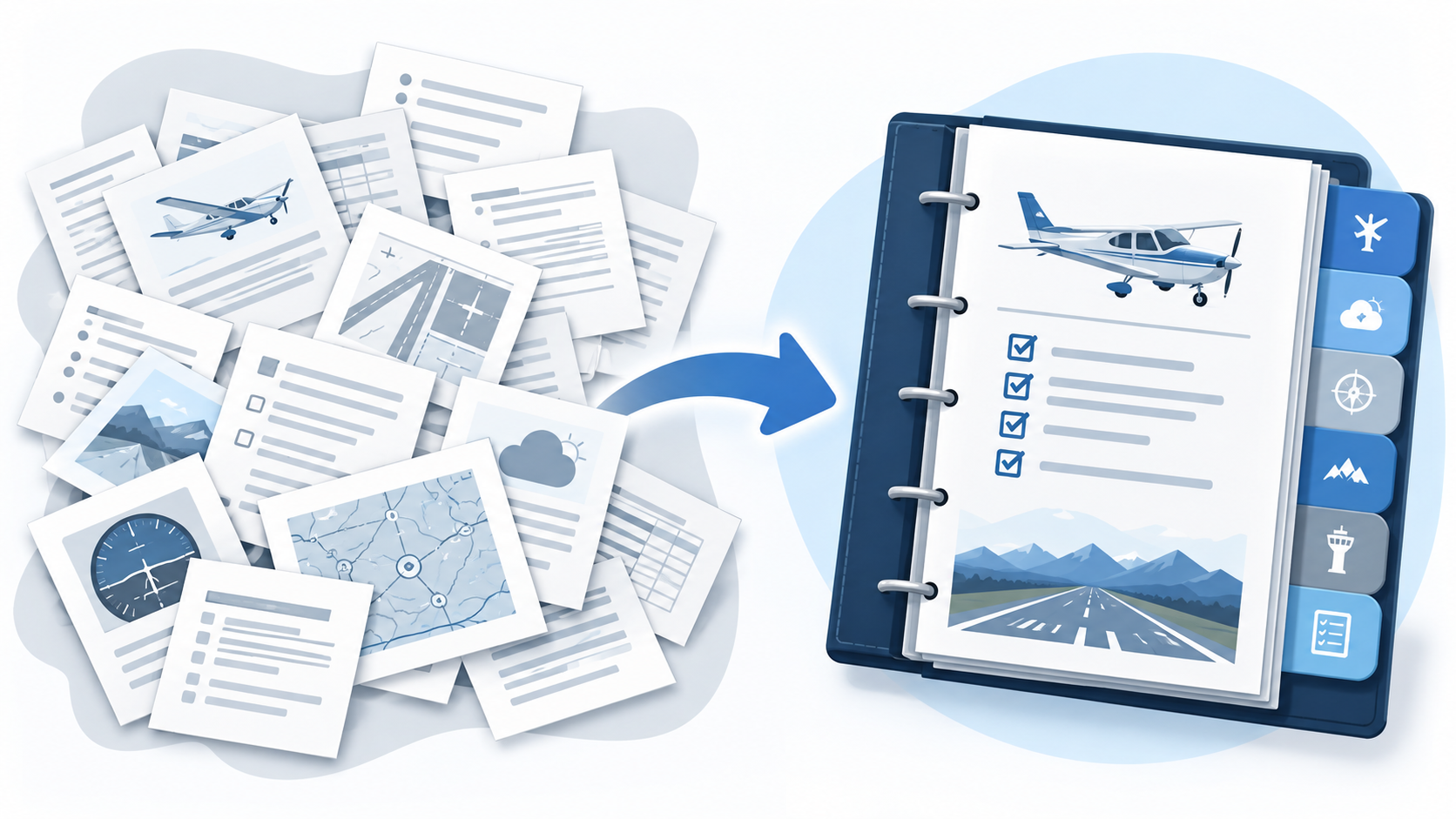
Here's the pivot. The instructors who seem to have their evenings back aren't smarter or more organized by nature. They built a lesson plan library once, then stopped treating every lesson like a blank page.
The Real Cost Isn't Time, It's Consistency
Rebuilding a lesson plan from memory every week costs you more than an hour. It costs you consistency, because tired-at-9pm-you writes a different lesson than sharp-at-9am-you. Your slow flight briefing on a Tuesday might cover completely different points than the one you gave the same maneuver two weeks earlier.
Students notice. Not consciously, usually. But they feel it when the ground briefing wanders, when the same question gets a different answer depending on the day, when the lesson doesn't build cleanly on the last one. The FAA's own Aviation Instructor's Handbook is built around the idea that structured, sequential instruction produces better learning outcomes than ad hoc teaching, and that's the whole argument in one sentence. A library isn't about saving you typing. It's about giving your students the same quality lesson whether you wrote it fresh or pulled it from a folder.
You're Not Behind, You're Under-Equipped
There's a difference between a CFI who's behind and a CFI who doesn't have the right tools. Most instructors think it's the first one. It's almost always the second.
A dedicated CFI who studied hard for the initial checkride still has to build an entire teaching practice from nothing the moment they start flying with real students. Nobody hands you a filing cabinet of maneuver briefings, ground lesson outlines, and stage check prep sheets on the day you get your temporary certificate. You build it yourself, lesson by lesson, usually the night before you need it. Knowing the fundamentals of instruction gets you the theory, not the finished library.
That's fine for the first six months. After that, you're not building a library anymore. You're just proving you can survive without one.
What a Real Lesson Plan Library Actually Does
A working lesson plan library isn't a folder of PDFs you downloaded once and never opened again. It does three specific things:
A Starting Point, Not a Blank Page
It gives you a starting point instead of a blank page, so your prep time goes into tailoring the lesson to the student in front of you instead of writing the lesson itself.
Consistency Across Every Briefing
It keeps your briefings consistent from student to student, which matters more than it sounds like it should when you're teaching the same maneuver for the two-hundredth time.
A Library That Improves With Use
It gets better every time you use it, because you're editing an existing plan based on what worked, not starting over.
That third one is the part most CFIs miss. The plan you use in October should be a better version of the plan you used in June. If it's not, you don't have a library. You have a pile.

The Actual Trade You're Making
Every hour you spend rebuilding a lesson plan is an hour you're not spending on ground school prep for a student who's about to bust their written, or on your own logbook, or honestly, on sleep. That's the trade. It's not lesson planning versus laziness. It's lesson planning versus everything else on your plate.
CFI Bootcamp built the Lesson Plan Bundle specifically so that trade stops being a tax on your evenings. It's not a magic replacement for knowing your material. It's a starting point that already reflects sound instructional sequencing, so your prep time goes where it actually matters.
For help beyond a single library, the CFI Gaps Course covers lesson planning and the other instructional gaps most new CFIs run into first.
Where This Leaves You
A lesson plan library won't write the lesson for you, but it should stop you from starting from zero. You didn't become an instructor to write lesson plans for a living. You became one to fly with students and watch them get better. The paperwork side of the job is real, but it shouldn't be eating the hours you'd rather spend flying, sleeping, or doing literally anything else on a Sunday night.
Fix the system once and the Sunday scramble stops being a monthly ritual.
For help building plans that hold up under real student questions, see our guide to flight instructor lesson plans that actually hold up on checkride day.
References
FAA Aviation Instructor's Handbook (FAA-H-8083-9) — https://www.faa.gov/regulations_policies/handbooks_manuals/aviation/aviation_instructors_handbook