You can explain airspace to a student cold. You can brief V-speeds without looking at a card. And yet the night before your own checkride, you're still flipping between three different PDFs, a stack of index cards, and a YouTube video from 2019, trying to find the one source that actually matches what your DPE is going to ask.
That's not a knowledge problem. That's a filing problem. Disorganized checkride prep fails people who know the material cold, every season.
Most applicants who bust a checkride knew the material. They just couldn't retrieve it fast enough, in the right order, under a little pressure, in front of someone whose job is to notice hesitation. Fix how your checkride prep is organized and the retrieval problem mostly disappears.
The Difference Between Knowing It and Finding It
There's a specific kind of panic that has nothing to do with actually knowing the answer. It's the panic of knowing you know it, somewhere, in one of four different resources, and not being able to pull it up in the two seconds a DPE gives you before your hesitation becomes part of the story they write up.
The FAA's Airman Certification Standards exist specifically to define what you need to know and how well you need to know it for each task on your checkride. That's the whole test, laid out in a single document. But most applicants build their checkride prep from five sources that each interpret the ACS slightly differently, which means their mental map of the material has five slightly different shapes instead of one clean one.
When your prep is scattered, your retrieval is scattered. When your checkride prep is organized around one consistent structure, you stop hunting for the answer and start just giving it.
Why "Studying More" Isn't the Fix
The instinct after a rough practice oral is to study harder. More hours, more flashcards, more YouTube. That's usually the wrong move, because the problem isn't volume. It's structure.
Adding more material to already-scattered checkride prep doesn't make retrieval faster. It makes it slower, because now you have six sources disagreeing slightly instead of five. The applicants who walk into a checkride calm aren't the ones who crammed the most hours. They're the ones whose material is organized the same way the ACS is organized, so there's no translation step between what they studied and what they're being asked.
What Organized Checkride Prep Actually Looks Like
Organized checkride prep has three qualities that scattered prep doesn't.
No Translation Between Study and Test
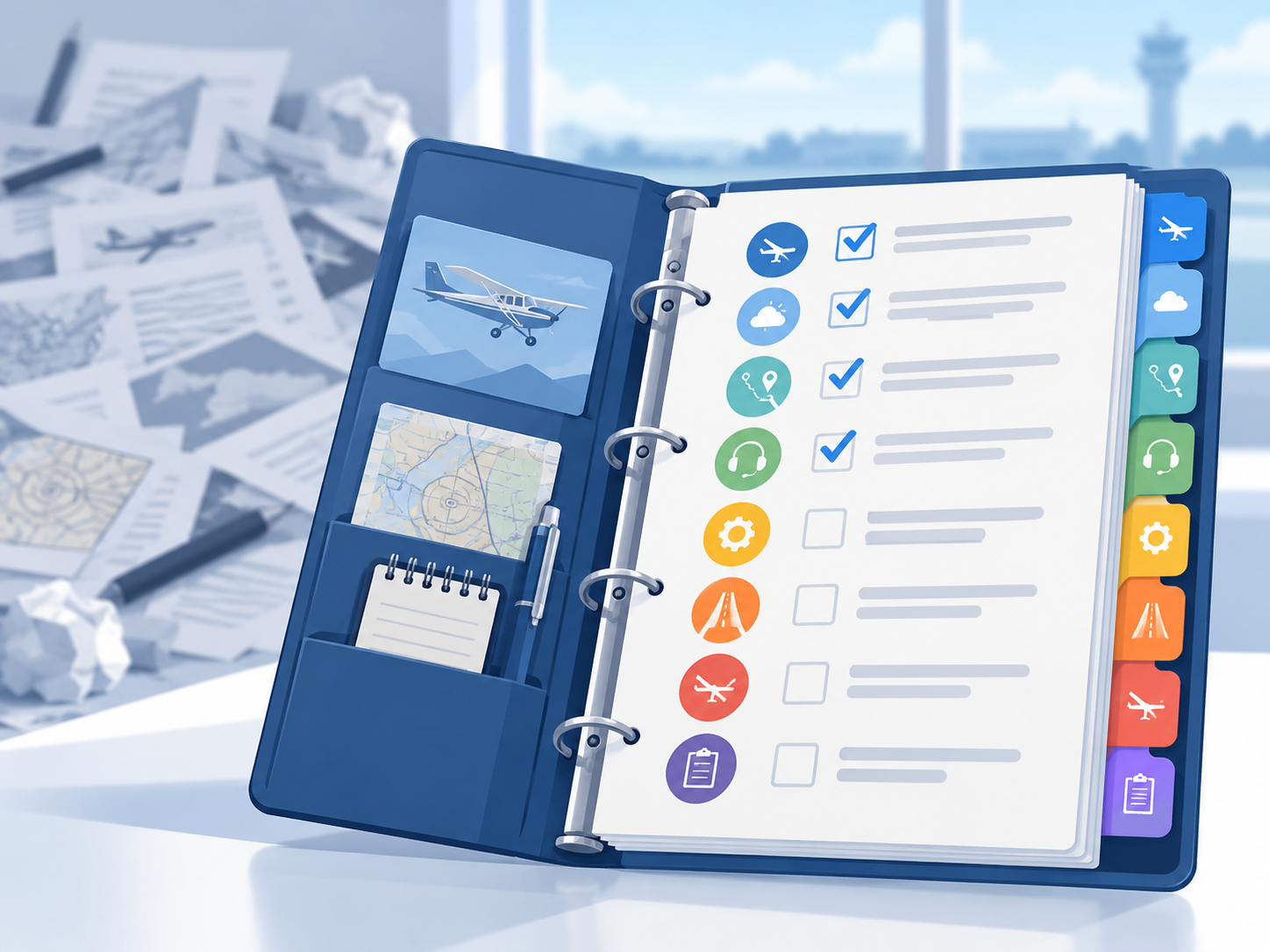
It follows the ACS structure directly, task by task, so there's no mental translation between what you studied and what the DPE is testing against.
Weak Areas Surface Early
It surfaces your weak areas early, because you can see gaps in a structured outline in a way you can't see them in a pile of disconnected notes.
Reviewable in Short Sessions
And it's reviewable in short sessions, because you're not re-reading a chapter every time, you're reinforcing a specific task you already have mapped out.
That third point matters more than it sounds like it should. Checkride prep that only works in two-hour blocks doesn't get done consistently. Checkride prep you can do in fifteen minutes between flights gets done every day, and consistency beats intensity almost every time.

The Applicant Who Actually Passes Relaxed
You've probably seen both versions of the same applicant. One shows up to the checkride visibly rattled, flipping through notes in the parking lot, hoping something sticks in the last ten minutes. The other shows up quiet, because they already know exactly what they know and exactly where the gaps were, and they closed them on purpose instead of hoping the DPE skips that topic.
The difference between those two people is almost never raw knowledge. It's whether their checkride prep gave them a clear picture of where they stood, or just a growing pile of material they hoped would be enough.
Where This Leaves You
You don't need to know more. You need to know what you know faster, and know exactly where the remaining gaps are before you're sitting across from a DPE finding out the hard way. Organize the prep once, and the confidence that comes with it does most of the work for you on test day.
That's the whole point of Smart Study Pro. Not more material. The material you already need to know, structured the way the checkride actually tests it.
References
FAA Airman Certification Standards overview — https://www.faa.gov/training_testing/testing/acs