Every CFI candidate starts the same way with their CFI Training. Buys the Aviation Instructor's Handbook. Subscribes to a low 200hr CFI on youtube. Downloads a lesson plan template somebody posted in a Facebook group in 2017. Builds a study schedule on a Sunday night that looks absolutely bulletproof.
Six weeks later, more low unqualified youtube channels have been subscribed to, three lesson plans are half-finished, and the checkride is still "a few months out."
Here's the part nobody says clearly: that's not a discipline problem. The candidate didn't get lazy. The training model itself is built wrong for this particular certificate, and it fails in three predictable places every single time.
Let's go through them.
The CFI Certificate Is Not a Self-Study Rating — And That's Not an Opinion, It's a Regulation
Every certificate up to this point rewarded you for studying alone. Private, instrument, commercial. You read the material, you flew the maneuvers, you passed the written. The knowledge lived in your head and the skill lived in your hands. Self-study worked because you were the one being measured.
The CFI flips that entirely. And the FAA wrote the flip directly into Part 61.
Under 14 CFR 61.187(a), you must receive and log flight and ground training from an authorized instructor on every area of operation for the rating you're seeking. Your logbook has to carry that instructor's endorsement certifying you're proficient to pass the practical test. There is no version of this where you read your way to the checkride and show up with a self-signed logbook.
It goes further. 61.185(a) requires logged ground training from an authorized instructor for CFI Training on the fundamentals of instructing, on the recreational, private, and commercial knowledge areas, and on the instrument areas if you're going for the CFII. The FOI portion gets waived in a narrow set of cases — you already hold a flight or ground instructor certificate, or you hold a current state teaching certificate at the 7th grade level or above. That's the entire list. If your plan was to argue your way out of it with a Duolingo streak and a strong sense of self, the FAA has anticipated you.
So the honest framing is this: you are legally required to be taught. Not supplemented. Not guided. Taught, logged, and endorsed by a qualified human being.
Which makes sense once you look at what's actually being evaluated. The output of this certificate isn't what you know — it's your ability to transfer what you know into somebody else's brain while they're actively confused about it. That's a performance skill, and you cannot self-grade a performance skill.
Studying to become an instructor by yourself is like practicing crosswind landings in a chair. You can absolutely rehearse the motions. You will feel very prepared. None of it survives contact with actual air.
The CFI oral is not a knowledge test. It's an audition. The examiner isn't checking whether you can recite the four fundamental skills — they're watching how you explain them to someone who doesn't have them yet. That gap is where the self-study candidate gets exposed, usually about forty minutes in.
The Instruction Quality Problem Nobody Wants to Say Out Loud
So you accept that you need an instructor. Fine. Most candidates then grab whoever has open slots on the schedule and consider the box checked.
That's the second failure.
Not Every CFI Is Legally Allowed to Train You
Here's the part that catches candidates off guard, sometimes after money has already changed hands.
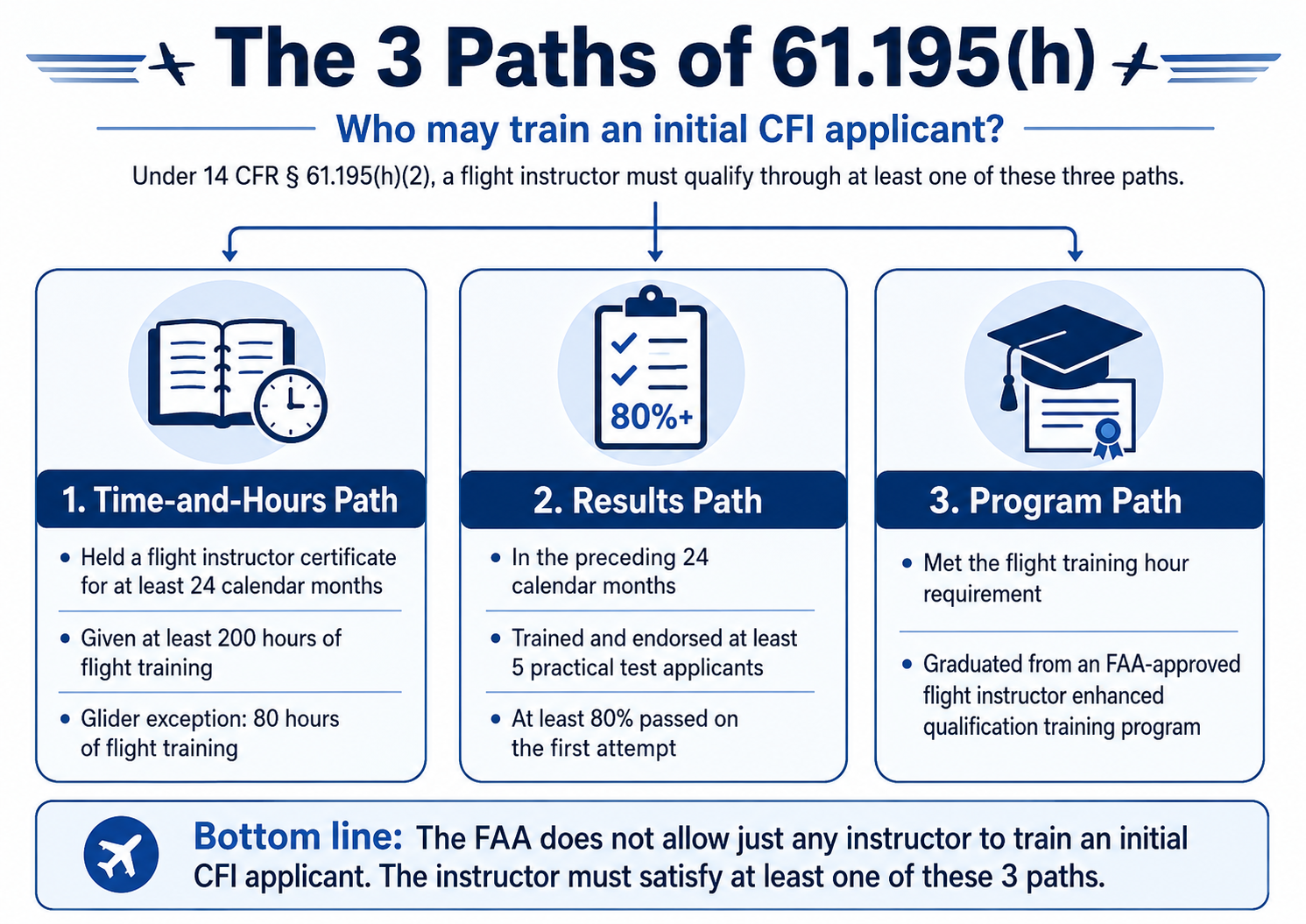
The FAA does not let just any flight instructor train an initial CFI applicant. Under 61.195(h)(2), the instructor has to clear one of three bars:
The time-and-hours path. Held a flight instructor certificate for at least 24 calendar months and given at least 200 hours of flight training. Eighty hours if it's glider.
The results path. Trained and endorsed at least five practical test applicants in the preceding 24 calendar months, with at least 80 percent of them passing on the first attempt.
The program path. Met the flight training hour requirement, then graduated from an FAA-approved flight instructor enhanced qualification training program.
Note that second one, because a lot of published guidance is still stale on it. That option arrived with the rule that took effect December 1, 2024. Before that, the alternative path demanded 400 hours of flight training given and service inside an FAA-approved course. Both of those requirements are gone. A newer instructor with a genuinely strong pass record can now qualify on results rather than tenure.
Read those three paths again and notice what the FAA is quietly telling you. Every single option is a proxy for the same thing: has this person actually produced instructors who pass? Two years and 200 hours is a proxy. Five endorsements at an 80 percent first-time rate is a more direct measurement. The enhanced qualification program is a structured version of the same idea.
Before you write a check, ask which of the three paths your instructor meets. If the answer is vague, that's your answer. And if it's the results path, ask for the number — anyone genuinely qualifying that way knows their pass rate to the decimal.
Authorized Is a Floor, Not a Standard
Clearing 61.195(h)(2) means your instructor is permitted to train you. It does not mean anyone ever taught them how to train a CFI candidate, because there's no standardized pipeline for that anywhere in general aviation.
So the gaps compound. Lesson plans get handed down that are really just the ACS with a border around it. Ground instruction becomes "read this chapter and we'll talk about it." The candidate never sees a maneuver taught from the right seat with running commentary, because their instructor has only ever been taught from the left.
And "technically authorized" is doing a lot of load-bearing work in some CFI courses right now.
Then there's the piece almost nobody addresses: what the examiner is actually evaluating. Having sat on the other side of that table as a former FAA and CAA Designated Pilot Examiner, Mike Shiflett can tell you the failure patterns are remarkably consistent with-in CFI Training. Candidates don't bust because they don't know the material. They bust because nobody ever showed them what instructional knowledge looks like when it's demonstrated out loud, under pressure, to a stranger. The fact of the matter is in most cases the student doesn't actually understand the material at a foundational level.
That's a training gap, not an intelligence gap. And it's fixable, but only if someone names it first.
If you want the specific breakdown of where these gaps show up and how they get closed, that's exactly what the CFI Gaps course was built to address. It's the diagnostic layer most CFI training skips entirely.
Momentum Is the Variable Nobody Puts on the Syllabus
The third failure has nothing to do with regulations or instruction quality. It's scheduling.
You book a Tuesday. The airplane goes down for a mag issue. You rebook for the following Saturday. Your instructor picks up a charter. You rebook for the Tuesday after that. Weather. Now it's been three weeks since your last flight, and the first forty minutes of the next lesson is spent recovering ground you already paid for once.
Your training calendar looks like a NOTAM for a closed airport — technically active, but nothing is actually happening.
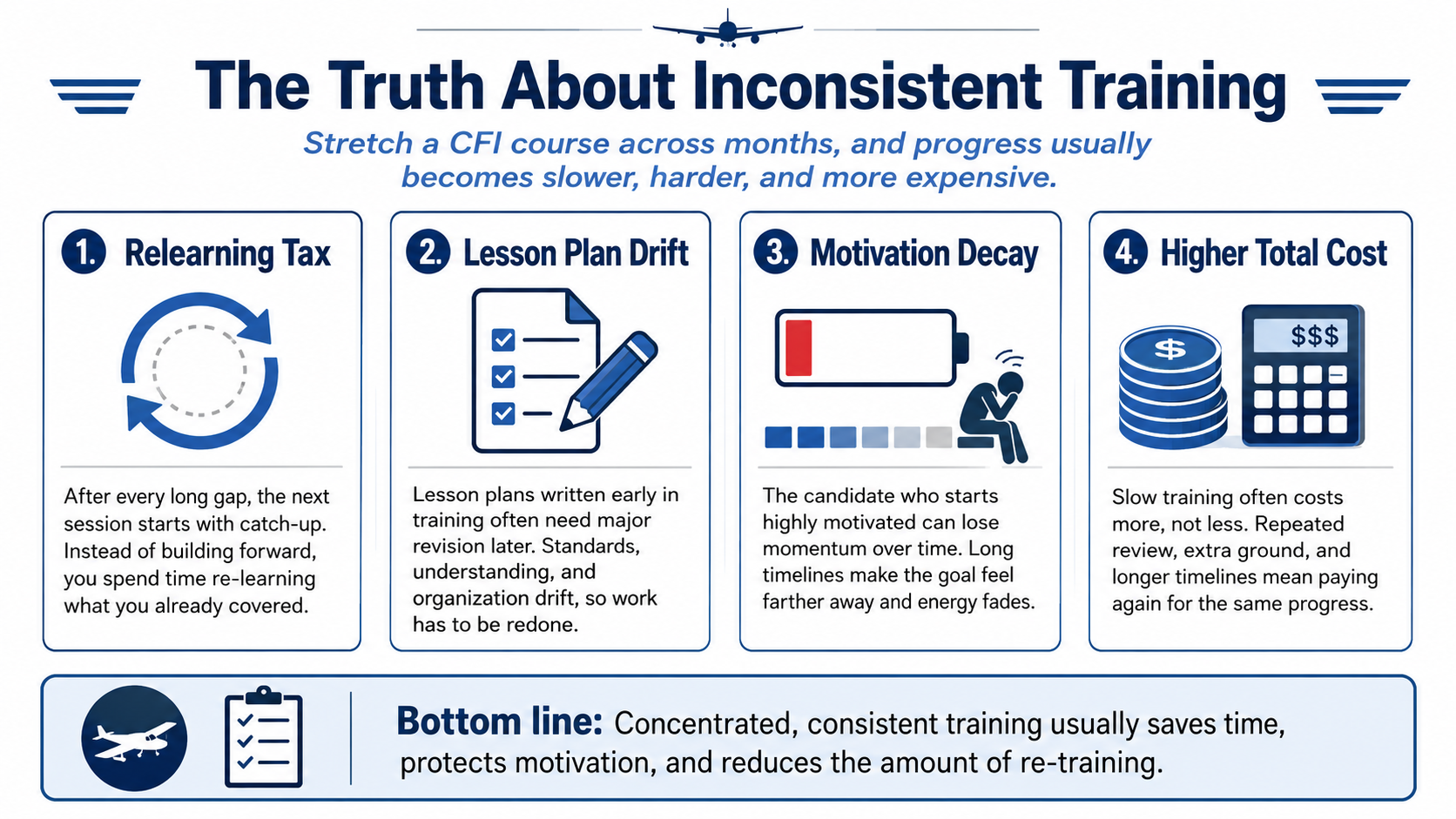
Stretch a CFI course across nine months and here's what you get:
Relearning tax. Every long gap costs you the first portion of the next session just getting back to where you were. That's not training. That's re-training.
Lesson plan drift. The plans you wrote in month two don't match the standard you're teaching to by month seven, so you rewrite everything anyway.
Motivation decay. The candidate who started fired up in January is answering "how's the CFI going?" with a shrug by August.
Higher total cost. This is the one that surprises people. Slow training is more expensive than concentrated training, because you pay repeatedly for the same ground.
The instinct is to go slow because it feels financially safer. It isn't. It just spreads the same bill over more months while quietly adding hours to the total.
What Structured CFI Training Actually Looks Like
Fix those three things and the outcome changes dramatically. Not because of some proprietary secret, but because the structure removes the failure points instead of asking the candidate to muscle through them.
Concentrated, scheduled blocks. The course runs on a fixed timeline with a defined start and end. Ground and flight are sequenced so each builds on the last while it's still fresh. No three-week gaps. No relearning tax.
Standardized, examiner-calibrated curriculum. Every candidate gets the same lesson plan framework, the same teaching methodology, and the same rehearsal of what the oral actually demands. Nothing is left to whichever instructor happened to be available that week.
Instructors who clear 61.195(h)(2) on purpose, not by accident. Not someone eight months ahead of you on the same path who technically found a way to qualify. The difference in what a candidate can demonstrate after two weeks of this is not subtle.
The Partnership Part Matters More Than It Sounds
Here's the piece that quietly does the heaviest lifting: strategic partnerships with flight schools, aircraft providers, and examiners so the airplane is never the bottleneck.
That sounds like logistics. It's actually the entire ballgame. Maintenance happens — that's aviation. But when there's a partnership network behind the schedule instead of one flight school's single available Cessna, a squawk becomes a swap instead of a two-week delay.
Same thing on the examiner side. Getting a checkride scheduled inside a reasonable window instead of waiting eleven weeks for a DPE slot means the candidate takes the ride while they're sharp, not after the knowledge has cooled off.
Add all of it together and the number that comes out the other side is a first-time pass rate approaching 90%. That isn't because the candidates are exceptional. It's because the three things that normally break the process were removed before training ever started.
The Certificate Where You Become the Product
Every rating before the CFI was about proving you could operate the airplane safely.
The CFI is the first one where you're the product. Somebody is going to trust you with their first solo, their first approach in actual, their kid's flight lessons. The examiner knows that. That's why the standard feels different, because it is different.
Training for it the same way you trained for your instrument rating is the mistake. Not a small one, either. It's the reason the average candidate takes far longer than they planned, spends more than they budgeted, and walks into the oral hoping rather than knowing.
The regulation already told you the answer. You are required to be trained by someone qualified to train you. The only real decision left is whether you pick that person carefully or take whoever's on the schedule Tuesday.
You don't need more study hours. You need a structure that was built for this specific certificate.
How CFI Bootcamp Actually Runs the Course
Everything above describes what breaks. Here's what replaces it.
The structure is three phases, and they run in that order for a reason. Each one closes a specific failure point before the next one opens.
Phase One: Online ACS Ground Prep — Before You Ever Show Up
You do not arrive at a bootcamp and start learning the material. You arrive already knowing it.
The 100% Online ACS CFI Course front-loads the aeronautical knowledge and the fundamentals of instructing so that the in-person time gets spent on delivery instead of definitions. You work through it on your own schedule, at your own pace, from wherever you are.
This phase exists to solve the single most expensive mistake in accelerated training: paying instructor rates to learn things you could have learned at your kitchen table. Candidates who skip this step spend the first two days of ground school catching up, and they never get that time back.
Ground training required under 61.185(a) still has to be received and logged from an authorized instructor. The online course sets the foundation; the logged instruction happens in Phase Two.
Phase Two: Scenario-Driven Ground School — Seven Days
This is where the certificate is actually won or lost.
Seven consecutive days of ground instruction built around scenarios, not lectures. You aren't reciting the elements of a chandelle. You're teaching one, out loud, to somebody who's going to interrupt you with the question a real student would ask.
The ACS language is demonstrates and simultaneously explains. That phrasing is deliberate, and it is not the same thing as knowing the maneuver. It means talking while flying, teaching while performing, staying ahead of the airplane and ahead of the student at the same time. That skill is built by repetition under observation, and there is no shortcut to it.
By the end of this phase you have lesson plans that survive questioning, a teaching methodology you've actually practiced, and a clear picture of what the oral is going to feel like. Most candidates report that the practice orals here are harder than the checkride. That's intentional.
Phase Three: Consecutive Flight Training — No Gaps
Then you fly. Consecutively.
Not one lesson a week around your instructor's charter schedule. Consecutive days, sequenced so each flight builds on the last while it's still fresh. This is the phase where the strategic partnerships with flight schools, aircraft providers, and examiners do the heavy lifting — because a maintenance squawk becomes a swap instead of a two-week delay.
Instruction comes from CFIs who clear 61.195(h)(2) deliberately and who have trained initial CFI applicants specifically. Not from someone eight months ahead of you on the same path.
Then the checkride gets scheduled inside a reasonable window instead of eleven weeks out, so you take the ride while you're sharp.
Three phases. No gaps. A first-time pass rate approaching 90%.
Start the Conversation
Most people call with the same three questions: how long it takes, what it costs, and whether they're actually ready to start.
Those are the right questions, and they're worth an actual conversation rather than a form submission.
Email: Nick@CFIBootcamp.com
Phone: 650-600-1021